


Dewa Sanzan: Discover Japan’s Sacred Mountains of Rebirth

Dewa Sanzan, located along the borders of Tsuruoka, Nishikawa, and Shonai in Yamagata Prefecture, refers to the three sacred mountains: Mount Haguro, Mount Gassan, and Mount Yudono.
During the Edo period, visiting these three mountains became known as a “Journey of Rebirth.” This journey symbolizes a pilgrimage through the present, past, and future.
Mount Haguro – the present and prayers for happiness in the current life.
Mount Gassan – the past and prayers for a peaceful afterlife.
Mount Yudono – the future and prayers for rebirth.
These mountains were founded about 1,400 years ago. Each one represents a different stage of life.

A Journey Through Japan's Heritage in Yamagata
Today, Dewa Sanzan is recognized as one of Japan Heritage sites. It preserves Japan’s deep connection between nature, spirituality, and culture. This story continues the journey we began with Japan Heritage, exploring how each site tells a story that shapes Japan’s spirit beyond tourist spots.
“Japan Heritage” is an initiative by the Agency for Cultural Affairs of Japan. It recognizes stories connecting history, culture, and local traditions across the country. Each story is brought to life by local communities who preserve and share the tangible and intangible heritage that makes their region unique.
Learning the stories behind each Japan Heritage site adds a deeper appreciation to the experience. Understanding the history shaped by local communities brings every landscape and tradition to life.
The Spiritual Significance of Dewa Sanzan
Dewa Sanzan is not just a physical journey; it is a spiritual one. The mountains serve as a reminder of the connection between humanity and nature. Each mountain offers a unique experience that resonates with the soul.
Visitors often find themselves reflecting on their lives as they ascend these sacred peaks. The journey is more than just a hike; it is an opportunity for introspection and growth.
Dewa Sanzan and the Practice of Shugendo
Shugendo is a unique Japanese religion. It teaches people to train both body and mind through mountain practice. The word Shugendo literally means “the path of training and gaining spiritual power.”
Since ancient times, Japanese people have believed that gods live in the mountains. They have respected nature as sacred. Based on this mountain worship, Shugendo combines elements of Buddhism, Shinto, and Taoism. It creates a practical way of spiritual training. Anyone, whether a monk or not, can practice it. Climbing mountains, meditating in nature, and overcoming hardships lead to enlightenment and help others.
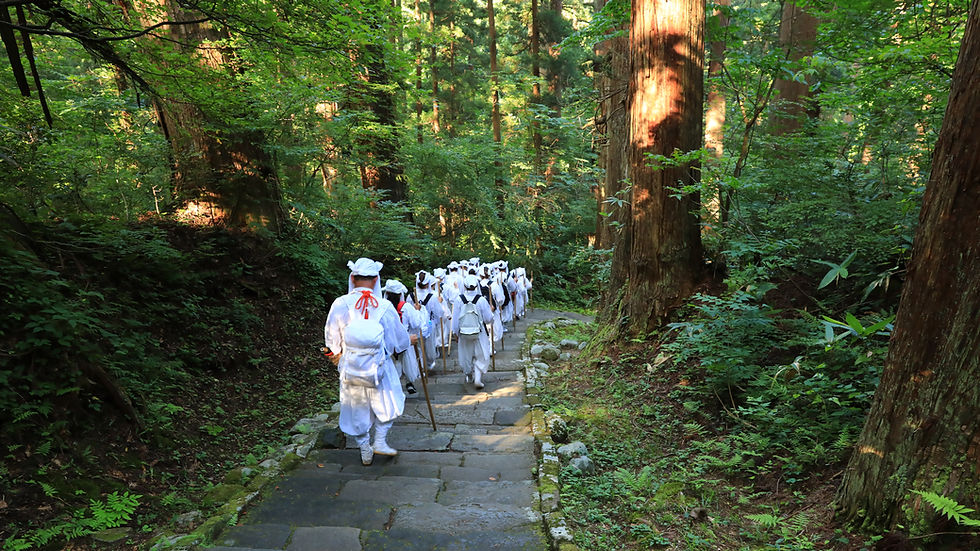
My father used to travel from Tokyo to Dewa Sanzan with members of his local community every two or three years to practice Shugendo, the traditional mountain training. Our family still keeps old records of our ancestors’ pilgrimages to Dewa Sanzan. This shows how deeply this spiritual tradition is connected to our roots.
Dewa Sanzan is known as one of Japan’s three major centers of Shugendo, along with Mount Hiko in Fukuoka and Yoshino in Nara. Even today, many yamabushi (mountain monks) continue their training there. They live in harmony with nature, keeping this ancient tradition alive.
Mount Haguro — The Present

Mount Haguro is known as the mountain where people pray for happiness in this world. From the entrance gate (Zuishinmon), a stone path of 2,446 steps goes up about 2 kilometers to the top of the mountain.

On both sides of the path stand tall cedar trees that are 300 to 500 years old. As you walk along the path, you will see the “Grandfather Cedar,” which is more than 1,000 years old. You will also see the beautiful Hagurosan Gojunoto (Five-Story Pagoda), a National Treasure of Japan.

The pagoda was first built in the mid-Heian period (931–938). It was rebuilt in 1372 and repaired in 1608. Made of cedar wood, it stands 29 meters tall. Even after hundreds of years, it still stands proudly. It is known as one of the Tohoku region’s oldest five-story pagodas.
Mount Gassan – The Past

Mount Gassan is the highest of the three sacred mountains of Dewa Sanzan, standing at 1,984 meters. It is known as the mountain of the past, where people pray for peace and comfort after death.

The summit is covered in deep snow for most of the year. The main climbing route to the top is only open from early July to mid-September. During this short summer season, visitors can enjoy lush alpine flowers as they make their way toward Gassan Shrine at the summit.

Although the summit trails gradually close from mid-September onward, the broader Gassan area transforms beautifully in autumn. Lower elevations—those not affected by early snowfall—are accessible longer into the season. They offer spectacular views of colorful autumn leaves. Even outside the climbing season, the mountain’s surroundings remain an exceptional place to experience the changing landscape.

Mount Yudono – The Future and Rebirth

Mount Yudono is known as the mountain of the future, where people pray for rebirth and new beginnings. The sacred area of Mount Yudono is unique. There are no large temples or shrines. Instead, the object of worship here is a massive ginger-colored rock that spouts hot water.

At the shrine, visitors take off their shoes and walk barefoot on the warm sacred rock, where hot spring water naturally flows from the mountain. This experience is said to wash away the past and welcome a new self, symbolizing spiritual rebirth.
What is Shojin Ryori and Shukubo?

A shukubo is a traditional lodging originally built for pilgrims visiting temples and shrines. During the Edo period, when pilgrimages became popular across Japan, there were said to be around 330 shukubo in the Dewa Sanzan area.
Today, 27 shukubo and inns remain in the Haguro area, and many are open to regular travelers.

By staying at a shukubo, visitors can experience Japan’s spiritual traditions. This includes shojin ryori (traditional Buddhist vegetarian cuisine, mainly featuring plant-based ingredients) and morning prayers with the monks.
My Reflections on Rebirth From the Sacred Mountains of Dewa Sanzan
Walking along the cedar path of Mount Haguro, surrounded by the morning mist, I felt a deep sense of calm. Through learning about Shugendo and meeting the yamabushi, I could truly feel the connection between nature and people. This faith has continued in Japan for centuries.
Dewa Sanzan is a very special place for me. My family has visited these sacred mountains for generations. I spent three years of high school at the foot of Mount Haguro. Whenever I return, it feels nostalgic—like coming back to where I truly belong. Being part of this Japan Heritage: Dewa Sanzan project felt almost like destiny.
Through our different journeys across Japan with Japan Heritage, from Dewa Sanzan to the Nakasendo Trail, and more recently to Onomichi, I’ve come to realize one thing: travel in Japan always connects people, time, and their stories.
Comments